If more than one drain in your house is backing up at the same time, if you're hearing gurgling from toilets or tubs nobody's using, or if water is pooling in your yard near where the sewer line runs, your main sewer line is probably clogged. Unlike a clog in a single sink or toilet, a main line clog affects your whole house at once, and it gets worse the longer it sits.
Mainline sewer clogs aren't some rare, freak occurrence. Across the California and Arizona markets Rooter Hero serves, they're the third most common plumbing problem we see, accounting for close to 14% of every completed job — more common than toilet clogs, more common than shower and tub clogs, and not far behind kitchen sink clogs. If you're dealing with this, you're not dealing with something unusual; you're dealing with something plumbers see constantly, and catch early more often than not.
8 Signs Your Main Sewer Line Is Clogged
Some of these signs show up on their own; most show up in combination. The more of them you're noticing at once, the more confident you can be that the problem is in the main line and not an isolated fixture.
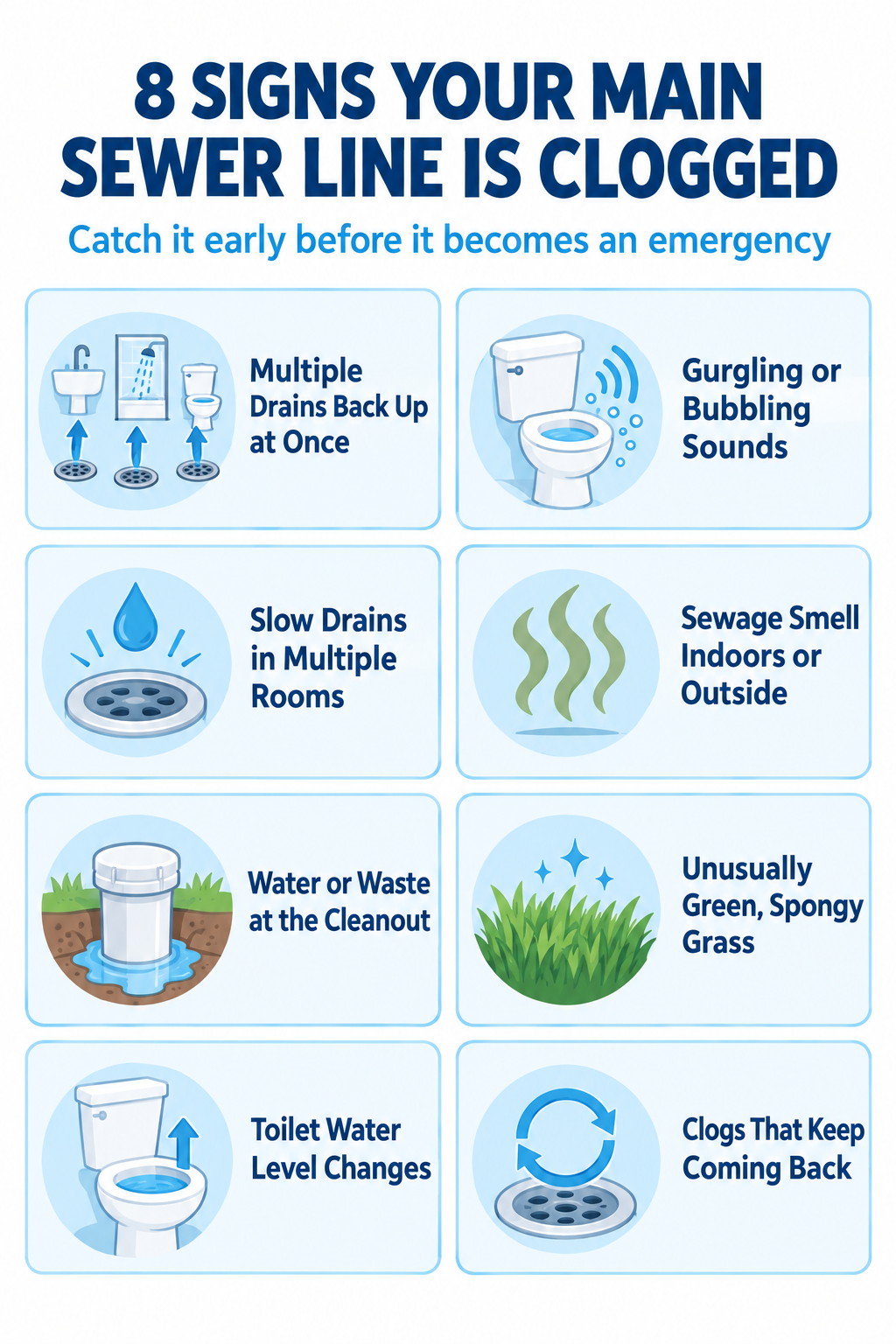
Here's the full list of signs you should look out for, in roughly the order homeowners tend to notice them.
Multiple drains back up at once: A single clogged toilet is annoying, but it's contained to that fixture. A main line clog isn't. Flush the toilet and watch the shower drain, or run the washing machine and check the kitchen sink. If water shows up somewhere it has no business being, the blockage is downstream of all of them, in the main line itself.
Gurgling or bubbling sounds from fixtures you're not using: When something blocks the main line, air gets trapped behind it. That air has to go somewhere, and it usually escapes back up through the water in your other drains — which is what produces the gurgling. If your toilet burps when the washing machine drains, that's not a coincidence.
Slow drains in more than one room: One slow drain is usually just hair or soap scum in that specific pipe. Slow drains in the kitchen, the bathroom, and the laundry room all at the same time point to something farther down the line, shared by all of them.
Sewage smell indoors or in the yard: A clog gives waste water somewhere to sit and gas somewhere to escape. If you're catching a sewage odor near a floor drain, in the basement, or out in the yard, that's usually the smell of wastewater that isn't moving where it's supposed to.
Water or waste surfacing in the yard, or at the cleanout: Your sewer cleanout (the capped pipe near your foundation or out by the street) is the pressure valve for your main line. If it's overflowing, or if you're finding soggy, foul-smelling patches in the yard that don't match recent watering or weather, water is backing up underground and finding a way out.
Unusually green, spongy grass over the line: This one sounds like good news until you know what causes it. Wastewater leaking from a cracked or clogged line acts like fertilizer. A strip of grass that's noticeably greener and springier than the rest of your lawn, tracking the path of your sewer line, is a sign of exactly that.
Unusual toilet water levels or slow flushing: Toilets sit lowest in most home plumbing systems, so they're usually the first fixture to show a problem. Water rising higher than normal, taking longer to drain, or reacting when you run other water in the house are all early tells.
It keeps happening: A single clog is a fluke. A drain that clogs again two weeks after you cleared it, in a pattern that keeps repeating, usually means the real obstruction is further down the line than a plunger or a bottle of drain cleaner can reach.
Is It the Main Line, or Just One Drain?
It’s worth understanding what type of clog you’re dealing with, because it changes how urgent the situation is and what it'll cost to fix.
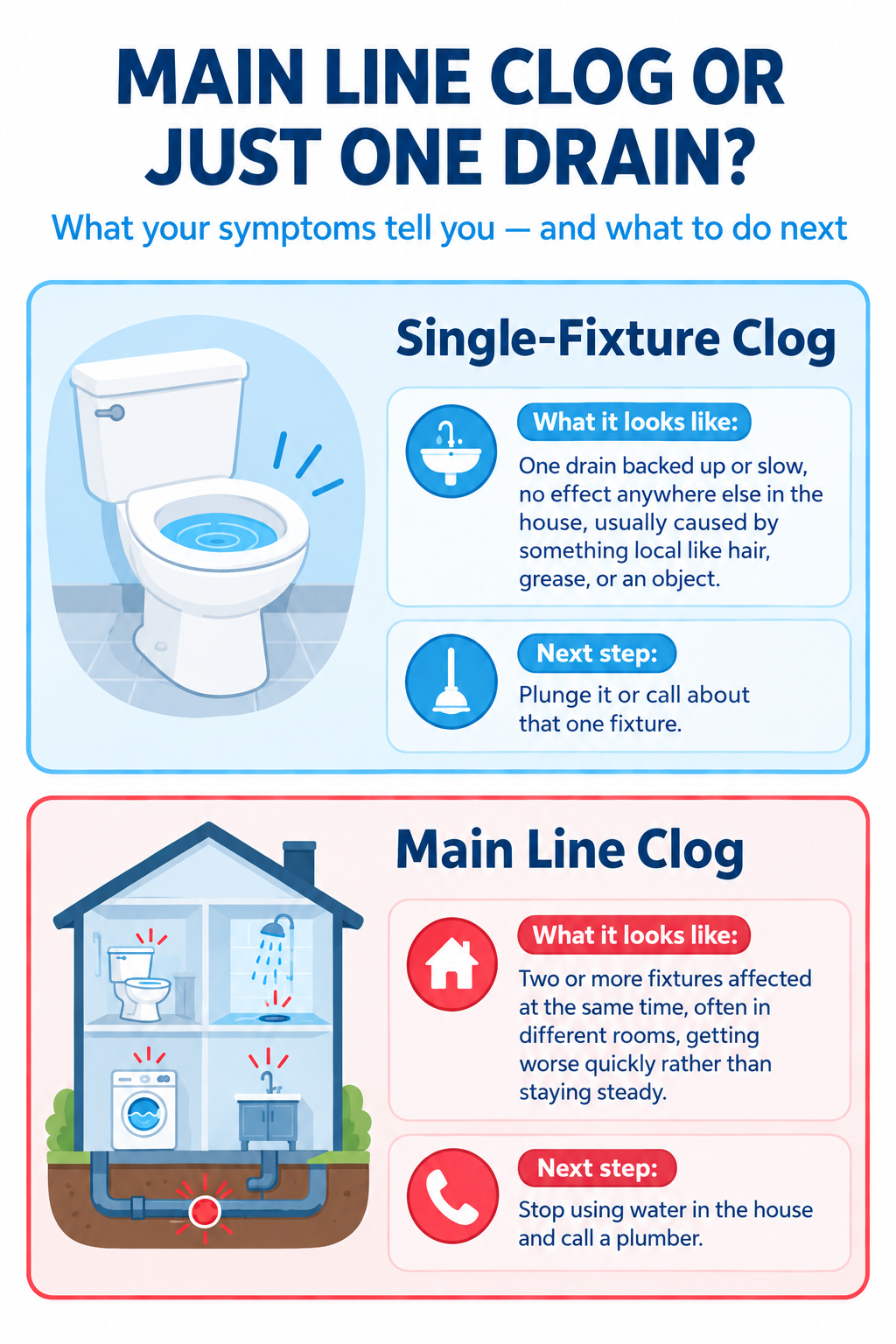
A single-fixture clog stays isolated — one slow or backed-up drain, no effect anywhere else in the house, usually caused by something local to that pipe (hair, grease, a kid's toy). A main line clog shows up in multiple places at once, often together, and tends to get worse fast rather than staying steady. If you're only seeing an issue in one spot, you're probably fine with a plunger or a call about that one fixture. If it's two or more fixtures, especially ones that aren't connected to each other in an obvious way, treat it as a main line issue.
Is This an Emergency? What to Do Right Now
Sewage backing up into a home isn't just inconvenient. It's a health hazard, and it causes real water damage in a short amount of time. Here's how to tell how urgent your situation is, and what to do about it immediately.
Call a plumber right away if:
Sewage or wastewater is coming up through a drain, tub, or toilet
More than one fixture is affected
You smell sewage inside the house
Water is pooling in the yard or around the cleanout
While you wait for help:
Stop running water anywhere in the house — every sink, shower, toilet flush, and load of laundry adds more volume to a line that's already blocked
Skip the liquid drain cleaner. It won't reach a clog that's this far down the line, and if the line backs up anyway, you're now dealing with chemical-laced sewage
Don't try to snake the main line yourself. A standard store-bought auger isn't built for it, and the wrong approach can push the clog further in or damage the pipe
This is also where cost tends to jump. Across Rooter Hero's service data, the average plumbing repair runs about $1,208 — but jobs that come in tagged as emergencies average $1,753. That gap isn't really about the clog itself getting more expensive to fix. It's about what happens in the hours between the first sign of trouble and the plumber showing up: more water pushed into an already-blocked line, more of it finding somewhere to go that isn't the sewer.
If you're in Orange, CA and dealing with any of the signs above, here's our guide to emergency plumbing in Orange — it covers what qualifies as a true plumbing emergency and how fast we can get someone out.
Why This Is a Bigger Deal in Older Orange Neighborhoods
Orange County doesn't have the rainy-season spike in mainline clogs that we see in markets like the East Bay or Sacramento, where clog volume more than triples between summer and winter as rain drives tree roots into aging clay pipes. Orange's job volume stays flat and steady all year instead. That's not necessarily good news, as it means the risk here isn't seasonal, it's constant.
The reason is the housing stock. A lot of homes in Orange's older neighborhoods still run on clay or cast iron sewer lines that were never built to handle 60, 70, or 80 years of root pressure and ground shift. Mature trees (ficus, pepper trees, eucalyptus) common in these same neighborhoods send roots looking for moisture, and a sewer line is exactly that. Combine older pipe material with aggressive root systems and you get a main line that's vulnerable year-round, not just after a storm.
What Causes a Main Sewer Line Clog
Most of these clogs come down to one of two things: something got into the line that shouldn't have, or the line itself is in bad enough shape that normal use is enough to back it up. Knowing which one you're dealing with makes a difference, since it changes whether the fix is a quick cleaning or something more involved.
Tree roots. The single biggest cause in older neighborhoods. Roots find their way in through pipe joints and cracks, then grow large enough to trap everything else flowing through. Hydro jetting is usually the most effective way to clear root intrusion once it's established.
Grease and oil buildup. Fat poured down a kitchen sink doesn't stay liquid once it cools. It coats the inside of pipes and narrows them over time.
Flushed wipes, paper products, and hygiene products. Even products labeled "flushable" often don't break down the way toilet paper does.
Pipe damage. Cracked, collapsed, or misaligned pipe — from age, shifting soil, or old pipe materials deteriorating — creates a spot where debris catches and builds up. If the camera inspection shows damage rather than just blockage, that's a sewer line repair job, not a cleaning job.
What Affects the Cost of the Fix
There's no single price tag for a main line clog, because the real cost driver isn't the clog itself — it's what's needed to clear it. A simple blockage near the cleanout costs far less to fix than a line that's cracked, bellied, or has roots grown through it six feet down. Depth, pipe material, and how easy the line is to access all play a part in the cost to fix, too. A plumber can't give you a real number until they've seen what's actually going on down there, which is why the diagnostic step matters as much as the drain cleaning itself.
Camera inspection: the starting point for almost every main line job. This is what tells your plumber whether they're dealing with debris, roots, a bellied section, or a cracked pipe, and it's what determines which of the methods below actually applies.
Snaking/augering: handles straightforward debris or grease clogs. Generally the least involved fix, assuming the pipe itself is intact.
Hydro jetting: called for when roots or heavier buildup have narrowed the line beyond what a cable can clear. More thorough, and typically more involved than snaking.
Trenchless repair or replacement: needed when the camera inspection shows actual pipe damage rather than just a blockage — at that point, no amount of cleaning fixes the underlying problem.
Frequently Asked Questions
Can I unclog a main sewer line myself?
For a true main line clog, no — not safely or effectively. A standard home auger doesn't have the length or power to reach a main line clog, and liquid drain cleaner won't do anything to a blockage that far from the drain opening. This is a job for a plumber with a main-line-rated machine or a hydro jetter.
How much does it cost to clear a main sewer line clog?
It depends on the cause and the method needed. A straightforward snaking job costs less than hydro jetting, and both cost less than a trenchless repair for a damaged pipe. The only way to get an accurate number is a camera inspection, since that's what determines which of those three you actually need.
Does homeowners insurance cover sewer line clogs or backups?
Usually not on its own. Most standard homeowner policies exclude sewer line damage and backups unless you've added a specific sewer or water backup rider. Check your policy or call your insurer before assuming you're covered.
How do I know if it's a clog or a broken pipe?
A clog usually causes slow drainage, gurgling, and backups that build gradually. A broken or collapsed pipe tends to show up as sudden, severe backup, sewage odor that doesn't go away, or soggy ground and sinking spots in the yard. A camera inspection is the only way to know for sure.
What's the fastest way to know if this is an emergency?
If sewage is actively coming up anywhere inside your home, or if more than one fixture is affected at once, stop using water and call a plumber immediately. Waiting tends to turn a clog into a bigger, messier, more expensive repair.
Noticing these signs at home?
A main line clog doesn't get better on its own, and the longer it sits, the more it costs to fix. Schedule service with Rooter Hero at (866) 941-8214 and we'll send a plumber out to diagnose it — no guessing, no upsell on a repair you don't need.