

You've already been through this once. Maybe twice. A plumber came out, ran a cable through the line, and everything drained fine again — for a while. Then the same slow drain, the same gurgle, the same backup showed up again, usually right around the time you'd stopped thinking about it.
That pattern is the actual problem here, more than any single clog. A line that clears and holds doesn't need an article written about it. A line that clears and then clogs again in a few weeks or months is telling you something: whatever got cleared out wasn't the real issue. It was just what happened to be blocking the pipe that day.
Clearing a Clog Isn't the Same as Fixing One
A cable or auger does exactly one job. It cuts or pushes through whatever's in the way and opens a path for water to move again. That's useful, and for a genuine one-time blockage (like a wad of wipes, a toy, or a buildup of grease), it's often the whole fix.
But a cable doesn't repair a crack that roots are growing through. It doesn't lift a section of pipe that's sunk and started collecting standing water. It doesn't reconnect a joint that's shifted out of alignment. All three of those conditions will produce a clog, get cleared by a cable, and then produce another clog later, because the thing that caused it is still sitting there. You're not re-experiencing the same problem. You're experiencing the same symptom from a cause nobody's addressed yet.
What a Clog That Keeps Returning Usually Points To
A single clog can be almost anything. However, a clog that keeps coming back usually narrows down to one of a few potential causes. Flushed wipes or a stray object get cleared and stay cleared. A recurring pattern points somewhere more specific:
An open root entry point. Roots don't go looking for your sewer line out of nowhere — they're drawn to a crack, a loose joint, or a connection that's already failed in some small way. A cable cuts the roots back and restores flow, but the opening they came through is still there. Left alone, new roots find it again, usually within a year or two.
A bellied section of pipe. When a length of pipe sinks or settles, it creates a dip where water pools instead of continuing downhill. Debris and waste that would normally keep moving settle into that low spot instead, and they'll keep doing it every time, no matter how many times the line gets cleared above and below it.
A shifted or separated joint. Pipe sections are connected, not poured as one continuous piece, and those connections can move with ground settling or age. A joint that's shifted creates a ledge inside the pipe — exactly the kind of edge that catches debris and starts a new blockage.
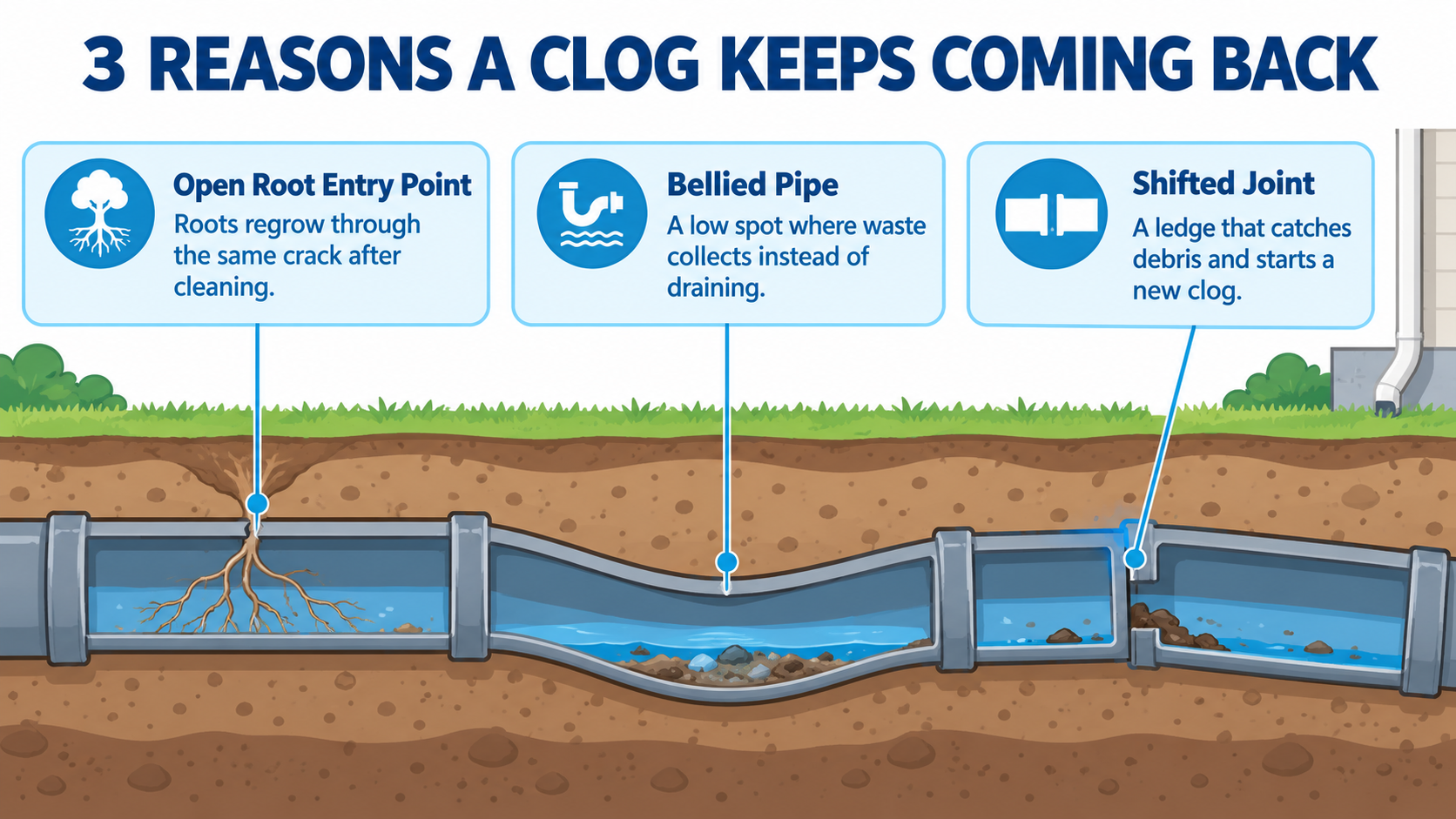
None of these issues are visible from the house itself. They're underground, often several feet down, which is why "it happened again" is the first real evidence most homeowners get that something structural is going on.
When It's Time to Stop Cleaning and Start Diagnosing
There's no fixed number of clogs that means you've crossed a line, but a few patterns are worth paying attention to:
The clog returns to the same general area of the house each time. If it's always the same low-lying fixture, like a shower stall or floor drain, that consistency usually means the blockage is forming in roughly the same spot in the pipe, not drifting around randomly.
It comes back faster each time. A line that held for a year, then six months, then two months, is on a trajectory — whatever's narrowing it is getting worse, not staying the same.
Cleaning fixes it for a shorter stretch every time. If a cabling service used to hold for months and now barely lasts a few weeks, that's often a sign the underlying opening or low spot has gotten larger.
Any of these is a reasonable point to ask for a camera inspection instead of another round of snaking. A camera doesn't guess. It shows exactly what's sitting inside the pipe — root mass, standing water in a bellied section, a visibly offset joint — and that's the only way to know whether the next step is another cleaning or an actual repair.
What the Camera Usually Settles
Three outcomes come out of that inspection, and they lead to three different next steps.
If the pipe itself is structurally sound and the issue is root growth or heavy debris, hydro jetting clears the full interior wall of the pipe rather than just punching a path through the middle of it, which tends to hold longer than a standard cable pass. However, if the root entry point itself isn't sealed, new growth can still eventually return.
If the pipe is bellied, cracked, or has a separated joint, no amount of cleaning solves it, because there's nothing wrong with what's blocking the pipe — the pipe itself is the problem. That's a sewer line repair conversation, and depending on the extent of the damage, it may mean a trenchless fix to that one section rather than a full line replacement
If the damage is extensive enough (such as old pipe material failing across most of its length), full replacement becomes the more honest answer, even though it's the one nobody wants to hear. Across Rooter Hero's service area, a full pipe repiping job averages $2,053, and that number runs roughly 85% higher in Orange County specifically than it does in a market like Phoenix; which is largely a reflection of how much older the underlying pipe infrastructure tends to be here. It's not a cost anyone wants to see, but it's a far more honest number than paying for a fourth drain cleaning job on a line that was never going to hold.
Why This Shows Up More in Older Orange Homes
Recurring clogs aren't evenly distributed. A newer home with PVC piping and no mature trees nearby rarely deals with this pattern at all, because there's no entry point for roots to find and no decades-old pipe settling to create a belly in the line.
Older homes carry more of this risk simply because they've had more time for something to go wrong underground. A joint that was installed correctly 50 years ago can still shift as the ground around it settles. A hairline crack that let in a single root a decade ago can let in a new one every year after that, regardless of how many times the line gets cleaned out above it.
With older homes in Orange, most big problems don’t arise from a single bad night, but through a slow pattern that eventually produces a major issue.
Keeping It From Coming Back a Third Time
A few things actually reduce the odds of a repeat, separate from the structural fix itself:
Schedule a camera inspection on a cycle rather than waiting for the next clog to force one, especially in a home built before the 1980s. Catching a small root intrusion or a minor joint shift before it causes a backup is a scheduled, inexpensive fix. Catching it after the third backup usually isn't.
Be honest about what's going down the drains in the meantime. Grease and wipes don't cause a recurring clog on their own, but they make a line with an existing structural issue fail faster and more often, since there's less usable space inside the pipe to begin with.
Ask directly whether a cleaning service included or ruled out a camera inspection. A straightforward cabling job without a camera pass doesn't tell you whether you fixed the cause or just bought yourself a few more months.
Frequently Asked Questions
Why does my main sewer line keep clogging?
Most of the time, it's because whatever's being cleared out — roots, debris, buildup — isn't the actual cause of the problem. The real cause is usually a crack, a settled low spot in the pipe, or a shifted joint, and none of those get fixed by cabling the line, which is why the clog eventually comes back.
Why does my sewer clog again right after it was cleaned?
A cable or auger opens a path through a blockage without correcting whatever created that blockage in the first place. If the underlying condition — a root entry point, a bellied section, a damaged joint — is still there, it's only a matter of time before something else collects in the same spot.
How do I stop my sewer line from clogging for good?
Start with a camera inspection rather than another round of cleaning. If the line is structurally sound, hydro jetting and a regular inspection schedule usually hold up well. If the camera shows a cracked, bellied, or offset section, the lasting fix is repairing or replacing that section, not cleaning around it indefinitely.
Does hydro jetting stop a sewer line from clogging again?
It helps more than standard cabling, since it clears the entire interior wall of the pipe rather than just a narrow path through the blockage. But if there's an open crack or joint that roots are using to get in, jetting won't seal that opening, and new growth can eventually return.
Is a recurring clog a sign I need a new sewer line?
Not always. Plenty of recurring clogs are resolved with a targeted repair to one damaged or bellied section, not a full replacement. A camera inspection is what tells you which situation you're actually in — there's no way to know from the house alone.
Schedule a camera inspection, not another cleaning.
If this is the second or third time you've dealt with the same backup, a camera inspection will tell you what's actually going on underground instead of guessing again. Schedule service with Rooter Hero and we'll show you exactly what we find before recommending anything.