

Water is coming back up through a drain, a toilet, or a tub somewhere in your house, and it isn’t going anywhere on its own.
Stop using every sink, toilet, and appliance that uses water right now, keep everyone and every pet away from the affected area, and call a licensed plumber.
That’s the short version.
Here’s the rest of it: what to do in the next few minutes, why this happens more in Orange than most people realize, and how to tell whether you’re dealing with something that can wait until morning or something that can’t.
The First Five Minutes
A few things matter more than anything else right after you notice a backup, and what you do in the first five minutes can determine how much worse the problem gets before you get it fixed.
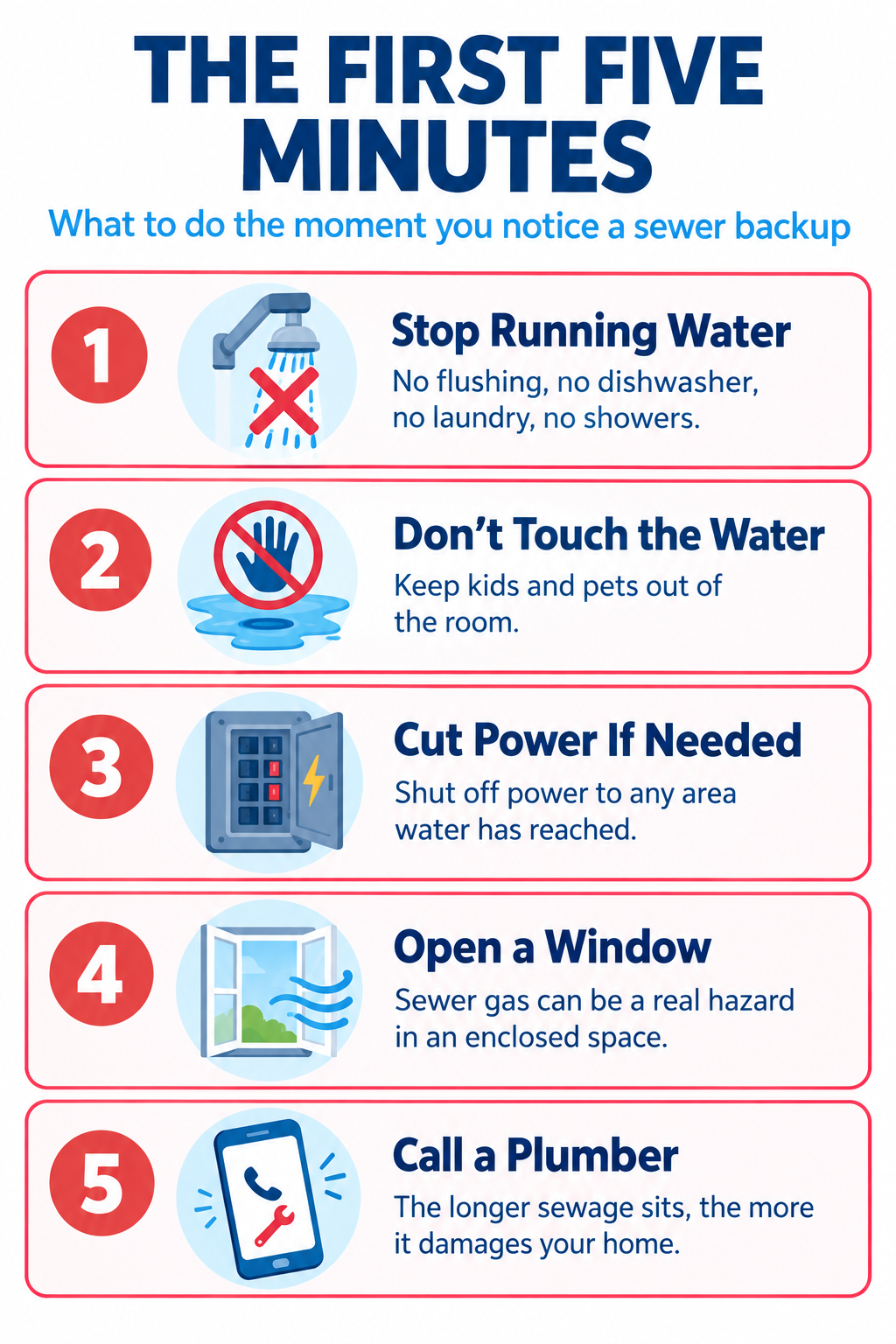
Stop running water anywhere in the house. No flushing, no dishwasher, no laundry, no showers. Every drain in your home ties into the same main line, and adding more water just pushes the backup further.
Don’t touch the water. Sewage carries bacteria and contaminants that can make you genuinely sick. Keep kids and pets out of the room entirely.
Cut power if needed. If water has reached outlets or any electrical fixtures, shut off power to that area at the breaker before you go anywhere near it.
Open a window if you can. Sewer gas isn’t just unpleasant. In an enclosed space, it can be a real hazard.
Call a plumber. The longer sewage sits, the more it damages flooring, drywall, and anything else it touches, and mold can set in within 24 to 48 hours.
That covers the emergency checklist. Everything past this point is about understanding what’s actually happening and whether you need someone there tonight or can get on a normal schedule tomorrow.
Why Orange Homes Deal With This More Than People Expect
Across the nine California and Arizona markets Rooter Hero serves, mainline sewer clogs are the third most common plumbing issue we handle, behind only kitchen sink clogs and general repairs, making up 13.9% of all completed jobs. That’s not a fluke tied to one bad season. It’s a function of what’s actually running underneath a lot of homes in Orange.
A good share of houses here were built between the 1950s and the 1980s, often on slab foundations with sewer laterals running beneath or through the concrete. Those lines don’t get easier to inspect just because nobody can see them, and plenty of homeowners have never had theirs looked at since the day they moved in. Add Old Towne Orange’s mature tree canopy into the mix, the same canopy that makes the historic district worth walking around in the first place, and you’ve got a lot of root systems that have had decades to work their way into aging clay pipes. The same holds true in the older, tree-lined pockets of Villa Park and Orange Park Acres nearby: bigger, older trees generally mean a longer-running risk underground, even if everything looks perfect above-ground.
Here’s the part that tends to surprise people: this isn’t a rainy-season problem here the way it is up north. Our internal job data shows mainline sewer clog volume in the East Bay and Sacramento more than triples between summer and winter, as seasonal rain pushes root intrusion to a head. But Orange County doesn’t follow that pattern. Demand here stays close to flat all year. A backup in your Orange home in July is just as likely as one in February, because it isn’t a storm causing it. It’s a line that’s been quietly losing capacity for years, finally giving out on an ordinary Tuesday.
Is It Your Line, or the City’s?
Knowing whose line it is is important, because it changes who you call first.
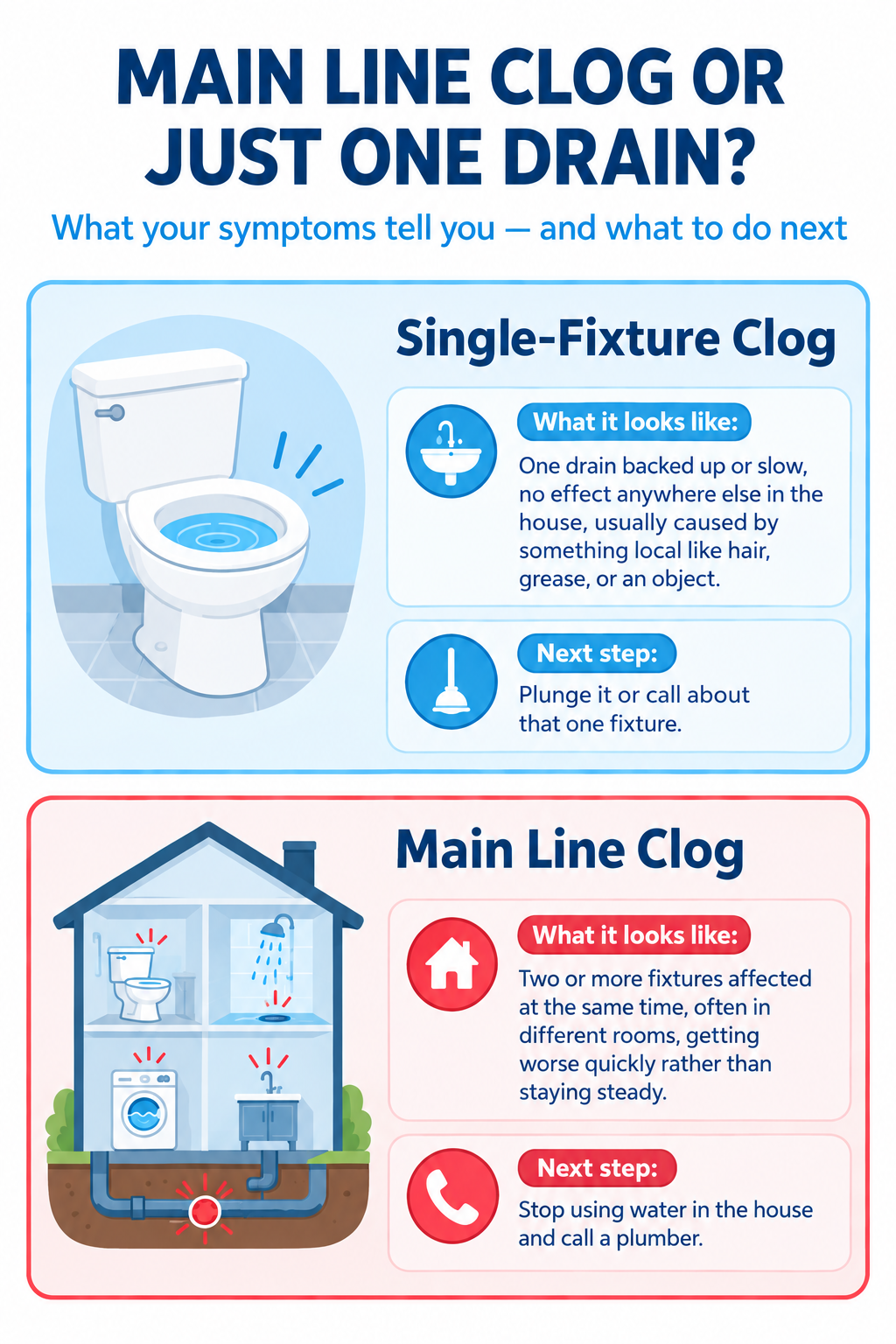
If one drain is slow or backing up (for example, just the kitchen sink or just one bathroom), that’s usually a localized clog in that fixture’s own line rather than a main line problem. If multiple fixtures across the house are backing up at once, especially the lowest drains in the house first, a shower stall or a floor drain, that almost always points to the main line. And if your neighbors are reporting the exact same thing at the same time, that’s a city main issue rather than something a residential plumber can resolve. That call goes to the city, not to us.
As the homeowner, you’re typically responsible for the lateral line running from your house out to the property line or the city’s connection point. Past that point, it becomes the city’s problem. Knowing which side of that line you’re dealing with before you start making calls saves real time during an emergency.
A gurgling sound from a toilet when you run the washing machine, or water rising in the shower when someone flushes elsewhere in the house, are both early tells that you’re looking at a main line issue rather than an isolated clog. Those symptoms are worth paying attention to even before a full backup happens, since they usually show up days or weeks ahead of one.
What Makes a Sewer Backup Worse
A few common instincts turn a bad situation into a worse one.
Running a drain snake blindly into a backup you haven’t diagnosed can push whatever’s causing it further down the line, or further into a crack you didn’t know existed.
Chemical drain cleaners do more harm than good once there’s standing wastewater. They don’t reach a main line clog, and they’re corrosive to leave sitting in a pipe that may already have other problems.
A plunger, useful for a single clogged toilet, does nothing for a backup that’s really a main line issue. All it buys you is a delay on the call you were going to need to make anyway.
When to Call Someone Right Now vs. When It Can Wait
If it's one slow drain and nothing else, you likely have a day or two to schedule service normally. If multiple fixtures are backing up, there's standing water on the floor, or it's been sitting for more than a couple of hours, that's a call-now situation. Every additional hour increases both the cleanup involved and the odds of real property damage.
When in doubt, call. A plumber can tell you over the phone whether what you're describing sounds like something that needs attention tonight or something that can wait for a normal appointment — you don't have to guess on your own.
What a Professional Response Actually Looks Like
A plumber showing up for a sewer backup isn’t just going to run a snake and leave. The first step is almost always a camera inspection: a small camera sent through the line that shows exactly what’s going on, whether that’s root intrusion, a collapsed section, grease and scale narrowing the pipe, or a joint that’s shifted out of alignment. That step is important, because clearing a backup without knowing what caused it usually just means you’re back here again in six months.
Once the cause is clear, the fix depends on what the camera found. A straightforward clog gets cleared mechanically. Heavier buildup or root intrusion running along the length of the line often calls for hydro jetting, which uses high-pressure water to clear the full interior wall of the pipe rather than just punching a narrow path through it the way a snake does. If the line itself is cracked or collapsed, the conversation changes to repair or trenchless replacement, as opposed to just cleaning it out.
Rooter Hero includes a free camera inspection with any standard drain cleaning service in Orange this month, and it’s worth asking about up front rather than after the fact. It’s the one step that tells you whether you’re looking at a one-time clear or a line with a bigger problem sitting underneath it.
Keeping the Next One From Happening
There’s no habit that fully prevents a sewer backup in an older home with mature trees nearby. That’s a structural reality, not a dishwashing problem. But a camera inspection every couple of years, especially in anything built before the 1980s, catches root intrusion and pipe wear while it’s still a scheduled fix rather than a middle-of-the-night emergency. If you’ve had more than one slow drain in the past year, that’s worth a look before it becomes a full backup.
Frequently Asked Questions
How do I fix a sewer backup myself?
In most cases, you shouldn’t try. A backup affecting more than one fixture is almost always a main line issue, and clearing it requires equipment, and often a camera inspection, that isn’t standard homeowner gear. The one thing you can safely do yourself is stop using water in the house and stay away from the affected area until a plumber arrives.
What causes a sewer backup in a house?
The most common causes are tree root intrusion into aging sewer lines, grease and buildup narrowing the pipe over years, a collapsed or offset section of pipe, and, less often, a blockage in the city’s main line affecting several homes at once.
Is a sewer backup an emergency?
If it’s affecting multiple fixtures, there’s standing wastewater, or it’s been sitting for more than a couple of hours, yes. Call a plumber right away. A single slow drain usually isn’t an emergency and can be scheduled normally.
How much does it cost to fix a sewer backup?
It depends on the cause and pricing varies based on what the fix involves. A simple clog clearing typically costs less; a damaged line needing repair or replacement will cost significantly more.
How do I know if it’s my sewer line or the city’s?
Multiple fixtures backing up at once in your home points to your own lateral line, which you’re typically responsible for up to the property line. If neighbors are reporting the same issue at the same time, it’s more likely a problem with the city’s main.
Why does my toilet gurgle when I run the washing machine?
That’s usually a sign of a partial blockage further down the main line, not a problem with the toilet itself. Air has nowhere to go when water moves through a restricted pipe, so it pushes back up through the nearest low-lying fixture. It’s worth having a plumber look at before it turns into a full backup.
If you’re dealing with a sewer backup in Orange right now, call Rooter Hero at (866) 941-8214. We’re available 24/7 and serve Orange and the surrounding Orange County communities.